
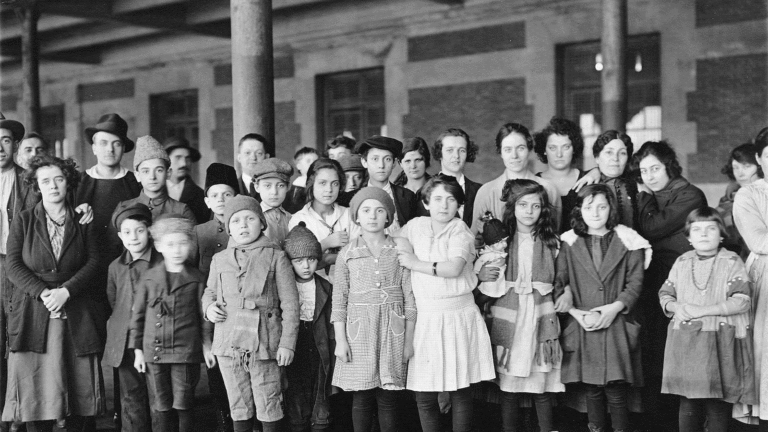
Every family tree carries silent anchors—pioneering ancestors whose quiet courage laid the groundwork for the generations that followed. For millions of Jewish families across the United States, the journey to America began at the turn of the 20th century. Between 1881 and 1924, more than 2.5 million Eastern European Jews left behind religious persecution, state-sanctioned violence, and severe economic restrictions in search of freedom and opportunity. Read on to learn how Jewish interest-free lending played a vital part in this history.
(PHOTO: Immigrant children at Ellis Island/National Archives, Wikimedia).
They boarded overcrowded ships with wooden trunks, family heirlooms, and a fierce commitment to building a better future for their children. Yet, upon passing through processing centers like Ellis Island, newly arrived families encountered a harsh new reality. They found crowded tenement housing, grueling factory hours, and an unfamiliar language.
The story of how these early generations survived—and ultimately thrived—is not just a story of individual grit. It’s a story of community solidarity, rooted in the foundational belief that preserving human dignity is essential when helping families stand on their own two feet.
The Realities of the Early Immigrant Household
When early immigrants arrived in urban centers like New York and Chicago, the financial strain on families was immediate. Entire households had to pool their energy just to pay rent on cramped tenement apartments.
- The Sweatshop and Pushcart Economy: Parents and older children often worked 12-to-14-hour days in textile factories, garment sweatshops, or as street peddlers.
- No Access to Traditional Banking: Mainstream financial institutions viewed newly arrived immigrants without established credit or property as “unbankable.” Commercial loans, when accessible at all, carried extortionate interest rates from predatory lenders.
- The Constant Threat of Setbacks: A sudden illness, a spike in costs, or a seasonal layoff in the garment industry often pushed a hard-working family from self-sufficiency directly into destitution.
In the face of these obstacles, families relied on a rich tradition of mutual aid. Neighborhoods organized Landsmanschaften (hometown fraternal societies) and Synagogues created emergency relief funds. In addition local leaders established Jewish interest-free lending — called Hebrew Free Loan societies — to provide a dignified alternative to charity or predatory debt.
How Interest-Free Loans Transformed Family Trajectories
Unlike traditional charitable handouts, which could leave recipients feeling beholden or dependent, Hebrew Free Loan were different. Operating on an ancient ethical model of zero-interest lending codified in Maimonides’ Eight Levels of Charity. they provided temporary financial capital. This enabled families to work their way through a crisis while preserving dignity.
A modest interest-free loan of $25 or $50 in 1910—funded by community donations and secured by the signatures of local neighbors—often served as a pivotal turning point for a family:
- Purchasing Tools of Trade: A loan allowed a tailor to buy his own sewing machine or a peddler to purchase a pushcart and inventory. This transformed underpaid day-laborers into independent small business owners.
- Securing Household Stability: During sudden emergencies or medical crises, interest-free lending kept food on the table and paid the landlord. This prevented eviction without forcing the family into compounding debt.
- Investing in the Next Generation: As small businesses stabilized, parents could afford to keep their younger children in school. This paved the way for the next generation to pursue higher education and professional careers.
Because borrowers paid back their loans in manageable weekly installments, the funds were recycled to help the next family in line. Today, this tradition continues internationally through members of the International Association of Jewish Free Loans (IAJFL). This cycle of recycled capital has created generations of financial mobility.
Carrying the Legacy of interest-free lending into the Modern Era
The world has changed significantly since the early 1900s, but the fundamental need for compassionate, dignity-first financial support remains. Today, families still navigate unexpected life transitions. Rising costs of higher education, small business startup hurdles, and sudden economic hardships are still realities.
Modern Jewish interest-free loan agencies continue the exact mission pioneered over a century ago. Institutions uphold the timeless practice of preserving dignity for every borrower who walks through their doors. They replace interest charges and bureaucratic hurdles with personal relationships and community trust.
When we honor the perseverance of our ancestors, we do more than look back at history—we carry forward their commitment to lifting up our neighbors with Jewish interest-free lending.
The Global Impact of IAJFL Today
The vision pioneered by 19th-century immigrant communities has expanded into a global network. Today, non-sectarian and Jewish free loan agencies across the globe collaborate under the umbrella of the International Association of Jewish Free Loans (IAJFL).
- Global Network: IAJFL unites more than 50 active member agencies operating throughout North America, South America, Europe, and Israel.
- Capital Managed: Together, IAJFL member agencies oversee more than $365 million in active free-loan assets.
- Recycled Capital in Action: Because repayment rates remain consistently near 99%, every dollar contributed to an IAJFL agency is loaned, repaid, and re-loaned repeatedly. Across the network, hundreds of millions of dollars are deployed each year. They fund college tuition, small business growth, adoption and fertility treatments, home security, and emergency relief.
Whether funding emergency relief during international crises or helping a local family navigate unexpected medical costs, IAJFL member agencies demonstrate the power of preserving dignity through non-predatory financial support.
Meeting a Modern Need: Why HFLSD Was Formed
San Diego had long been home to a vibrant and growing Jewish population. For decades however the region lacked sufficient localized demographic data regarding economic vulnerability. That changed when community leaders and local partner organizations initiated a groundbreaking demographic assessment—later expanded into the comprehensive report, A Blueprint for Our Future: San Diego Jewish Community Study.
The findings illuminated a critical reality: thousands of local Jewish households were living in poverty or experiencing severe financial insecurity without a dedicated zero-interest safety net. Recognizing that temporary financial shocks could easily push hard-working families into long-term distress, community leaders founded Hebrew Free Loan of San Diego (HFLSD) five years ago to close this critical gap. By bringing the proven, time-tested Free Loan model to San Diego County, HFLSD established a permanent local resource dedicated to financial empowerment through accessible, zero-interest loans.
Continue the Legacy of Mutual Aid with HFLSD
The same spirit of resilience, dignity, and community support that sustained early immigrant families lives on today in San Diego County.
Whether you are navigating an unexpected financial challenge, launching a small business, or pursuing higher education, Hebrew Free Loan of San Diego is here to help you achieve financial independence without the burden of interest.
- Need Financial Support? Discover our interest-free loan programs and see how simple it is to apply by visiting the HFLSD Loan Programs Page.
- Want to Pay It Forward? Help recycle capital for local families in need. Your tax-deductible gift directly funds loans for San Diegans—100% of repaid funds are re-loaned to support future borrowers. Learn how to give on the HFLSD Donate Page.